
What is the actual number of sexual partners you have had?

What is the actual number of sexual partners you have had? Calculate it and find out what it means. For example, did you know you may have had over 4,000,000 sexual partners? Learn how to calculate yours and what this means.
We all know how many sexual partners we have had in the past. But, even if this number is small for some or significant for others, are you sure that this number is valid?
The number of people you have had sex with is more than you realize. This is because although you know your direct sexual contacts, we usually don’t count indirect sexual contacts, that is, the contacts that partners have had and the contacts of partners’ contacts.
The consequences are alarming, as the higher this number of indirect sexual exposures, the greater the risk of contracting a sexually transmitted infection.
Calculate the number of your sexual partners
By using the calculator below, you can calculate the number of people the number of people you’ve been exposed to up to six degrees of connection. Sexual exposure is based on the Six Degrees of Separation theory, which calculates the number of indirect sexual contact according to the number of previous sexual partners a person has had.
It is noted that the purpose of the calculator is not to create panic but to raise awareness about STDs by showing you the exponential effect of sexual contact and highlighting the risks of spreading sexually transmitted diseases and the importance of regular preventive examination, as long as the intercourses are unprotected.
Enter the number of straight partners you’ve had and how many partners you estimate each of those partners had before you to see the true scale of your sexual exposures throughout six degrees:
Possibility of exposure to disease
More than 30 different bacteria, viruses and parasites are known to be transmitted through sexual contact, including vaginal, anal and oral sex.
Some sexually transmitted infections can also be passed from mother to child during pregnancy, childbirth and breastfeeding. Eight pathogens are associated with the highest incidence of sexually transmitted disease (STD). Four of these are currently curable: syphilis, gonorrhoea, chlamydia, and trichomonas. The other four viral infections still have no definitive cure: hepatitis B, herpes simplex virus (HSV), HIV, and human papillomavirus (HPV).
Check your symptoms in an easy, quick and anonymous way
Most of the population certainly knows about the risks and also about sexually transmitted diseases; however, a large part of them does not visit a doctor to make a diagnosis and, most importantly, to find a solution to their problem for three main reasons:
1. For financial reasons
2. For practical reasons
3. For emotional reasons
For example, someone may live in a remote area without access to a doctor. But there is also the case that someone is embarrassed to visit a doctor, especially concerning sexually transmitted diseases, which, even nowadays, (unfortunately) remain to be taboo. Through Docandu’s Dermacare, you can easily, quickly and anonymously check symptoms and find a solution to your potential problem; if you have any concerns consult your dermatologist or visit Dermacare here.
Over 1,000,000 million sexually transmitted diseases every day
More than 1 million STDs are acquired daily. In 2020, WHO estimated 374 million new infections with 1 of 4 STDs: chlamydia (129 million), gonorrhoea (82 million), syphilis (7.1 million), and trichomoniasis (156 million).
Over 500 million people aged 15-49 are estimated to have genital herpes simplex virus (HSV) infection.
Human papillomavirus (HPV) infection is associated with more than 311,000 cervical cancer deaths yearly. In addition, nearly 1 million pregnant women were estimated to have been infected with syphilis in 2016, resulting in over 350,000 adverse complications during pregnancy.
Methodology
Sexual exposure was derived using established formulas for a finite geometric series, which, when applied to this situation, allow the following formula for sexual exposure to be derived:
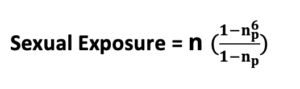
n = number of partners you have had
np = number of partners your partner have had before you on average
Sources
- James C, Harfouche M, Welton NJ, et al. Herpes simplex virus: global infection prevalence and incidence estimates, 2016. Bull World Health Organ. 2020;98(5):315-329.
- Bray F, Ferlay J, Soerjomataram I, Siegel RL, Torre LA, Jemal A. Global cancer statistics 2018: GLOBOCAN estimates of incidence and mortality worldwide for 36 cancers in 185 countries. CA Cancer J Clin. 2018 Nov;68(6):394-424. Epub 2018 Sep 12. Erratum in: CA Cancer J Clin. 2020 Jul;70(4):313.
- Unemo M, Lahra MM, Escher M, Eremin S, Cole MJ, Galarza P, Ndowa F, Martin I, Dillon JR, Galas M, Ramon-Pardo P, Weinstock H, Wi T. WHO global antimicrobial resistance surveillance (GASP/GLASS) for Neisseria gonorrhoeae 2017-2018: a retrospective observational study. Lancet Microbe 2021; 2: e627–36